

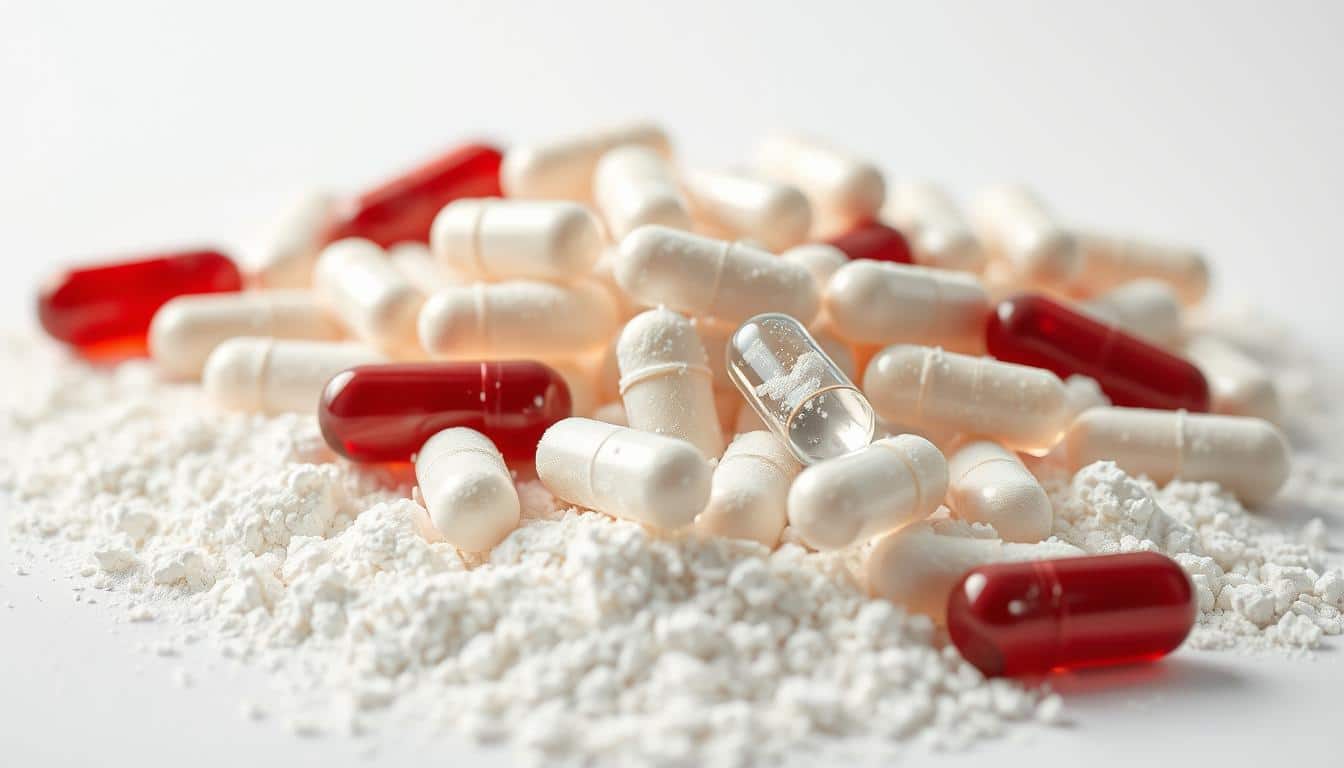
I’ve watched players win and lose seasons while wrestling with sore knees, and that’s why I look closely at collagen for joint support in athletes. The idea is simple: this protein forms the scaffolding of tendons and ligaments, so it matters when you train hard.
Tendons are 65–80% protein by dry weight, and hydrolyzed products deliver small peptides that enter circulation. Several trials in active people show lower pain scores and better function with 5–10 g per day over 12–24 weeks.
I’ll give direct advice on doses, timing, and pairing with vitamin C. I’ll also compare hydrolysates to native type II and show which outcome measures, like VAS and KOOS, track progress best.
Key Takeaways
- Collagen can reduce joint pain in short-term trials at 5–10 g/day.
- Hydrolyzed peptides absorb quickly and may aid mobility.
- Vitamin C helps the body build structural protein.
- Use VAS or KOOS to measure changes clearly.
- Whey boosts muscle synthesis more than collagen in direct protein comparisons.
- Type II native works differently (oral tolerance) than hydrolysates.
Search intent and who this guide helps today
If you train hard and feel persistent soreness, you want clear, evidence-based next steps. I wrote this article to give practical answers you can use this week.
What athletes want to know right now
They ask: will daily collagen reduce pain and speed recovery? Short answer: some trials show benefit. Varsity and recreational athletes in several studies had less joint pain at rest and during activity after 12–24 weeks of 5–10 g/day of collagen peptides.

How this guide uses clinical trial evidence
I focus on randomized trials and two systematic reviews (2020 and 2024). I explain which outcome measures mattered, like VAS and KOOS, and I report typical results and timelines.
- What you can do now: try 5–10 g/day and track VAS scores weekly.
- Check this: swelling, locking, or sharp pain need clinician review.
- Combine with: vitamin C and loading sessions to help tissue synthesis.
| Dose | Duration | Typical outcome |
|---|---|---|
| 5 g/day | 12 weeks | Small pain reduction, mobility gains |
| 10 g/day | 12–24 weeks | Moderate improvement on VAS/KOOS |
| Whey (compare) | Short term | Better for muscle synthesis than peptides |
What collagen is and why joints depend on it
I see how tissue damage changes performance. I want to explain the main building blocks that keep athletes moving.
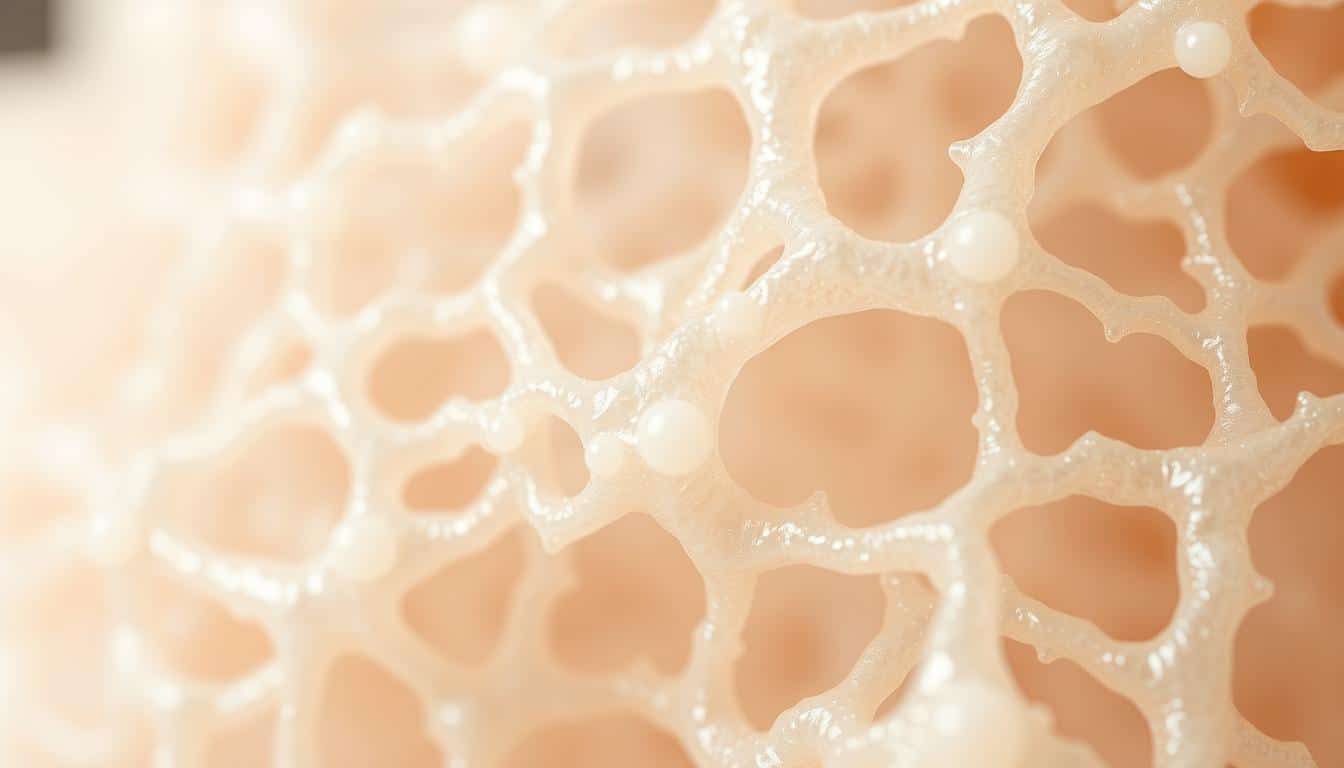
Collagen is a structural protein. It makes about one-third of human protein and gives tendons and cartilage their strength.
Type I and type II: where they live and what they do
Type I is the major form in tendon, ligament, and bone. Tendons are about 65–80% protein by dry weight, mostly collagen. Crosslinks between fibers let tendons handle high loads.
Type II dominates articular cartilage. This is the tissue that lines the knee and hip. It resists compression during running and jumping.
- Training loads stress the matrix and trigger remodeling.
- Hydrolyzed peptides are small fragments from enzymatic breakdown and absorb into blood after you drink them; some studies show detectable peptides in circulation.
- Native type II keeps its triple-helix and may act via oral tolerance mechanisms seen in a study of immune-driven cartilage conditions.
These features explain the potential impact of supplements on joint health and pain. They also set up how peptides plus exercise might change results in later sections.
How collagen hydrolysate works with exercise
I explain this in practical terms so you can act on it. Give cells the right substrate and a mechanical signal, and they make more matrix. That simple pairing drives measurable changes over weeks.
Hydrolyzed peptides, absorption, and the connective tissue matrix
Hydrolysate enters the bloodstream after you drink it. Small peptides appear in circulation within an hour. That puts building blocks near tendon and cartilage cells when they need them most.
Load-driven signaling and vitamin C co-ingestion
Mechanical loading triggers a cascade that tells cells to raise matrix production. When peptides are present during that window, studies show higher synthesis. Lab-linked human models noted increased synthesis with a 15 g dose about an hour before loading.
- Action: take a hydrolysate dose 30–60 minutes before heavy loading.
- Action: add a vitamin C source to help hydroxylate proline and lysine so new fibers form correctly.
- Note: this targets the connective tissue matrix, not muscle protein synthesis; pain and improvement show gradually over weeks.
collagen for joint support in athletes: quick answer
When recurring soreness starts to dictate your training load, you need a clear yes-or-no on whether supplements can help. My short answer: yes — with conditions.
When it makes sense: I recommend a trial if you have recurring knee pain that limits range or volume during training or games. Studies in varsity and recreational athletes show 5–10 g/day over 12–24 weeks reduced VAS scores and improved function. Achilles tendon rehab also improved when peptides were paired with daily eccentric work.
How to try it: Take 5–15 g/day for 12 weeks. Use the dose 30–60 minutes before your rehab or strength session and add vitamin C. Pair the supplement with a structured loading plan — not as a stand-alone fix.
- Log VAS pain at rest and during activity each week.
- Stop if there is no change by week 12 or if pain worsens.
- See a clinician for swelling, locking, or giving way.
| Use case | Typical dose | Duration to judge | Most likely benefit |
|---|---|---|---|
| Recurrent knee pain with activity | 5–10 g/day | 12–24 weeks | Reduced pain, better function |
| Tendon rehab (Achilles) | 5–15 g/day + eccentric loading | 12 weeks | Improved VISA-A scores |
| Main goal = muscle building | Consider whey/protein | Short-term | Better muscle synthesis than peptides |
Evidence from randomized controlled trials in athletes
Let’s look at what randomized trials actually measured and what the numbers show.
Joint pain and function: key results and effect sizes
I reviewed clinical trial data where participants took supplements while following rehab or training. A 10 g daily dose for 24 weeks cut pain at rest and during activity on the VAS in varsity players and lowered use of other therapies.
Another trial gave 5 g/day for 12 weeks to active adults and found greater knee pain reduction than placebo. Function scores improved alongside lower analgesic use.
Muscle soreness and jump performance recovery
One study used 20 g/day and tested 150 drop jumps. Soreness at 48 hours was lower and counter-movement jump height recovered faster. Blood markers of inflammation did not change.
Tendon-focused findings
Several trials paired a 5 g dose with tendon rehab. Ankle exercises raised CAIT scores. Daily eccentric calf work plus the supplement improved VISA-A in Achilles symptoms.
High-load training with 15 g/day showed small increases in tendon or muscle CSA in some groups. Overall effects were moderate and accumulated over weeks, not days.
- Summary of findings: multiple studies show reduced joint pain with 5–10 g/day over 12–24 weeks.
- Performance note: 20 g/day shortened soreness and aided jump recovery at 48 h.
- Practical point: use these numbers to set targets when you log pain and function.
| Outcome | Dose | Typical change |
|---|---|---|
| VAS pain (rest/activity) | 5–10 g/day | Small to moderate reduction over 12–24 weeks |
| Muscle soreness / CMJ | 20 g/day | Lower soreness at 48 h; faster CMJ recovery |
| Tendon scores (VISA-A / CAIT) | 5 g/day + eccentrics | Improved clinical scores and some CSA gains |
Outcome measures that matter: visual analogue scale and function scores
Good tracking separates placebo from progress; that starts with the right pain and function scales.
Visual analogue scale (VAS) is a 0–100 line where you mark pain. Use it at rest and during a standard task to capture change over time.
Analogue scale basics: mark the same way each week. A single number makes trends easy to read and compare to study results.
- WOMAC / KOOS: knee-focused tools that score pain, stiffness, and function. These show mobility and activity changes in trials.
- Lysholm: a sport-minded knee score that tracks stability, limp, and strength during activity.
- ROM: knee flexion and extension measured with a goniometer; simple and objective.
Trials reported reduced pain on VAS and gains on KOOS and Lysholm after 12–24 weeks. Some studies showed both patient and physician VAS improvements.
At home, pick one pain scale and one function scale. Log weekly. Use a single task (a squat or a 10-minute run) when you record activity pain to reduce noise.
Set a goal: a 20–30% improvement is a meaningful difference. Share logs with your coach or clinician so they can adjust training or rehab.
| Measure | What it records | How to test weekly |
|---|---|---|
| Visual analogue scale (VAS) | Overall pain at rest and during activity | Mark 0–100 at rest and after a standard task |
| KOOS / WOMAC | Pain, stiffness, function for knee | Complete the questionnaire every 2–4 weeks |
| Lysholm | Knee stability and sport function | Score symptoms and performance weekly or biweekly |
| ROM | Knee flexion/extension degrees | Measure with goniometer during the same warm-up |
Forms you can buy: collagen hydrolysate, collagen peptides, native type II
Not all products are the same; the form you buy decides how it acts in the body.
Hydrolysate / peptides are low-molecular-weight fragments. They dissolve easily and absorb quickly into blood. That makes them a good match for a pre-workout dose paired with loading.
Undenatured (native) type II keeps the triple-helix structure. It likely works via an oral tolerance immune pathway and is often chosen for symptomatic knee osteoarthritis rather than immediate tissue building.
Sources and practical choices
- Type I material typically comes from skin, bone, or tendon (bovine, porcine, or marine).
- Type II usually comes from cartilage, often chicken sternum (poultry).
- Pick a source that fits allergies, ethics, and dietary preferences.
- Check labels for the exact form and dose per serving. Avoid blends that hide the active dose.
| Form | Mechanism | Typical use case |
|---|---|---|
| Hydrolysate / peptides | Small peptides absorbed quickly; substrate supply | Pre-loading with training; tendon or cartilage synthesis |
| Undenatured type II | Oral tolerance immune route; anti-inflammatory signal | Symptom-focused use for knee OA and chronic inflammation |
| Source choice (bovine/porcine/marine/poultry) | Different amino profiles and allergen/ethics profile | Choose based on diet, allergies, and testing standards |
Bottom line: both forms have human data, but mechanisms and dosing differ. Match the product to your training plan and read labels closely to judge efficacy and actual dose per serving.
Dosing ranges, timing, and stacking with training
Pick a dosing plan that matches your training load and give it time to show results. I outline clear dose bands, simple timing rules, and a practical example you can use this week.
Common daily doses
- 5–10 g/day — a starter option aimed at reducing pain and improving function over 12–24 weeks.
- 15 g/day — targets synthesis when paired with loading; used in lab work showing increased matrix production.
- 20 g+ — used around very hard eccentric sessions to reduce soreness and speed CMJ recovery at 48 hours.
Pre-exercise window and vitamin C
Take the dose 30–60 minutes before your rehab or strength block. That timing places peptides near cells during peak signaling.
Add 50–100 mg vitamin C with the dose to help new fiber formation. Split doses if you train twice daily.
| Goal | Typical dose | Timing |
|---|---|---|
| Joint pain reduction | 5–10 g/day | Daily, 30–60 min pre-session |
| Matrix synthesis | 15 g/day | 60 min before short loading bouts |
| Soreness recovery | 20 g/day | Pre- and/or post-hard eccentric work |
Example: mix 15 g peptides with orange juice and drink 45 minutes before lifting. Track pain and function weekly for at least 12 weeks. If you get GI upset, lower the dose and try another product form or brand.
What improvements to expect and by when
D
Pain reduction, mobility gains, and activity tolerance
Real-world results follow a timeline: small early signals, clearer improvements by week 12, and slower tissue changes after that. I’ll lay out what to watch and when to reassess.
Early signals (week 2–4): expect small changes in pain during daily tasks. A subtle drop on your VAS is a good sign.
Short term (weeks 8–12): this is when clearer improvement appears. Studies show better VAS, KOOS, and Lysholm scores in knee groups by week 12.
Fast soreness wins (48 hours): higher doses around hard eccentric work can cut soreness by day two. That effect shows in jump protocols using 20 g/day.
- Define a meaningful VAS change as 20–30% from your baseline.
- Look for easier stairs, smoother squats, and longer runs with less pain.
- Expect mobility gains as less morning stiffness and fuller ROM on repeated tests.
- Not everyone improves; across RCTs of type I hydrolysate positive outcome rates averaged ~0.49.
- Reassess at week 12 and decide whether to continue, adjust dose, or stop.
| Timeframe | Likely change | How to judge |
|---|---|---|
| 2–4 weeks | Small pain reduction | Weekly VAS drop of a few points |
| 8–12 weeks | Clearer pain and function gains | 20–30% VAS improvement; KOOS/Lysholm rise |
| 48 hours (post-eccentric) | Lower soreness | Faster CMJ recovery; less DOMS |
Remember: tendon remodeling often lags pain changes. Keep loads progressive and steady to turn early effects into lasting improvement.
How collagen compares with other proteins for recovery
I compare how connective tissue and muscle respond to protein so you can pick what to use around hard training.
What each protein targets: Small peptides raise collagen synthesis in tendon and cartilage. A 15 g dose increased collagen production in lab-linked models and some trials. By contrast, whey and leucine-rich proteins drive muscle protein synthesis more reliably at rest and after lifting.
Practical plan: take peptides 30–60 minutes before loading to target connective tissue. Use whey or mixed proteins after sessions to maximize recovery and muscle repair. You can include both in a day if you split timing.
Quick comparison
- Peptides: best to boost tendon and cartilage matrix when paired with load.
- Whey/mixed protein: best to raise muscle protein synthesis and strength gains.
- Soreness relief from peptides does not equal greater muscle growth.
| Goal | Typical dose | Timing |
|---|---|---|
| Connective tissue synthesis | 10–15 g | 30–60 min before loading |
| Muscle protein synthesis | 20–30 g whey or mixed | Immediately after exercise |
| Combined plan | Split doses (peptide + whey) | Peptide pre-load; whey post-session |
Who benefits most: athletes, active adults, and patients
Certain groups show bigger gains than others, and that matters when you decide to try a product.
Recreational athletes with knee discomfort
I see the strongest pain signals in recreational athletes with knee issues. Trials report clearer VAS and function gains with 5–10 g/day over 12–24 weeks.
Tip: pair the dose with a structured lower-body program and log weekly VAS scores.
Older adults and women in resistance programs
Older adults and women doing resistance training showed better fat-free mass and strength when given 15 g/day versus placebo in some studies.
Tip: use low- or high-load strength work depending on tolerance and track strength tests every 4 weeks.
- Patients with osteoarthritis: a few studies show WOMAC and MRI gains; coordinate dosing and monitoring with a clinician.
- Tendon pain: add daily eccentrics and take the dose shortly before rehab sessions.
- Competitive athletes: test changes during off-season blocks and set clear targets for pain and function.
| Group | Typical dose | Expected result |
|---|---|---|
| Recreational athletes (knee) | 5–10 g/day | Lower VAS; better function at 12–24 wks |
| Older adults / women (RT) | 15 g/day | Improved strength and lean mass vs placebo |
| Osteoarthritis patients | 5–15 g/day (clinician advised) | WOMAC and MRI changes over months |
Study design signals: clinical trial quality and consistency
Not all studies are equal; the design often decides whether results are useful. I teach you quick checks that flag trustworthy trials and weak claims.
- Double-blind + placebo — this reduces bias in pain outcomes and keeps subjective ratings honest.
- Isonitrogenous comparators — whey or lactalbumin controls help separate protein effects from specific peptide actions.
- Baseline balance — groups must start with similar pain and function scores, otherwise results can mislead.
Check duration and adherence. Many clinical trial protocols run 12–24 weeks, which fits tissue remodeling. Dropout rates averaged near 17% across studies. A 2024 review reported a mean positive outcome rate ~0.49 for joint endpoints and ~0.4 overall.
How to read results: look beyond p values. Note effect sizes and confidence intervals. See if authors report adherence to dose and training. Prefer valid endpoints like VAS, KOOS, and VISA-A.
| Signal | Why it matters | What to check |
|---|---|---|
| Blinding & placebo | Reduces expectation bias | Describe who was blinded and how |
| Isonitrogenous control | Separates generic protein from specific peptide effects | Compare protein and calorie matching |
| Endpoints & baseline | Ensures valid comparisons | Look for VAS, KOOS, VISA-A and similar scores |
Run your own mini trial: log baseline VAS and a function score, follow the protocol, and reassess at 12 weeks. That will help you judge real-world efficacy versus published findings.
Safety, quality, and label checks
Not all powders are equal; a quick label check protects your health and your training. I start by verifying third-party testing and exact ingredient forms. That simple step saves time and reduces risk.
Dose adherence, ingredient form, and third-party testing
What I check:
- Third-party testing: look for NSF or Informed-Sport seals to confirm purity and batch testing.
- Exact form: confirm hydrolysate or undenatured type II on the label, not a vague blend.
- Active grams: verify grams per serving, not scoop size, so dosing is precise.
- Check source (bovine, marine, poultry) to match dietary needs and allergy risks.
- Avoid unnecessary fillers and added flavors that add no value.
| Check | Why it matters | Quick action |
|---|---|---|
| Third-party test | Verifies label claims and limits contaminants | Choose NSF or Informed-Sport |
| Form & dose | Determines mechanism and effective parameters | Confirm hydrolysate/undenatured & grams |
| Source & batch | Allergy and traceability impact | Log batch number and expiry |
Practical tips: start at 5–10 g/day to test GI tolerance and build a daily habit to keep adherence >80%. Note allergies to fish or poultry cartilage. Track batch numbers and discuss any new product with your sports dietitian or team staff. Also review funding and authors of key trials to judge impact and bias when you read claims about a dietary supplement.
Practical plan for athletes in the United States
I’ll give a clear, week-by-week plan you can use with your coach or clinician. This is a simple protocol built from trial results and real-world rehab practice.
Step-by-step: dose, timing, training, and tracking
Dose: start 10–15 g daily for 12 weeks. This matches many studies that tracked pain and function.
Timing: take the dose ~45 minutes before strength, plyo, or rehab. Add 50–100 mg vitamin C with the drink.
Training: pair with progressive lower-body strength work. Add daily eccentric reps for tendon issues (calf eccentrics for Achilles; slow squats for patellar).
Soreness days: on heavy eccentric sessions consider a single 20 g dose to help next-day function.
How to log pain and function with simple scales
I recommend two quick tools you can use on your phone or in a notebook.
- Visual analogue scale (VAS): mark pain 0–100 at rest and after a 10-rep bodyweight squat.
- Function test: KOOS pain + function subscales every 2–4 weeks, or a timed 2-minute step test weekly.
Weekly review: aim for a 20–30% pain improvement by week 8–12. If pain rises or function falls for two consecutive weeks, pause and reassess with your care team.
| Action | Details | When to judge |
|---|---|---|
| Dose | 10–15 g daily (20 g on heavy eccentric days) | Start baseline, check at 12 weeks |
| Timing | 45 minutes pre-session + 50–100 mg vitamin C | Each training day |
| Training | Progressive strength; daily eccentrics for tendon pain | Adjust load every 2 weeks |
| Tracking | VAS at rest and post-squat; KOOS or step test | Weekly logs; formal review at 8–12 wks |
| Team sync | Share logs with coach, PT, or ATC weekly | Weekly |
What research still needs to answer
I see several clear gaps that shape how we interpret current results. These are practical questions I want trials to answer so coaches and clinicians can act with confidence.
Key unanswered questions
- Elite load: How do elite competitors respond during heavy-season cycles?
- Sex differences: Do women show different effects across menstrual stages or menopause?
- Peptide profiles: Which peptide mixes drive the largest pain and function changes?
- Scaling dose: Should dose rise with body size or weekly load volume?
- Tendon imaging: How does tendon structure change on ultrasound and MRI over a season?
- Durability: How long do benefits persist after stopping supplementation?
- Predictors: Which outcomes best forecast a safe return to full training?
- Head-to-head: How does native type II compare directly with hydrolysate in active groups?
- Interactions: Does combining supplements or NSAIDs alter adaptive tissue responses?
- Bias checks: How do funding and authorship affect reported efficacy and study design?
| Priority | Needed data | Why it matters |
|---|---|---|
| High | Large trials in elite cohorts | Real-world impact on season performance |
| Medium | Sex-specific imaging and biomarkers | Tailored dosing and timing |
| Low | Funding transparency analyses | Trust in reported results |
Conclusion
Conclusion
After reviewing trial data and practical plans, I give a short take-home: targeted supplementation can reduce pain and improve mobility when paired with loading and vitamin C. Studies and real-world protocols show the best effect with about 5–15 g daily, timed before rehab or strength work, and measured over 12–24 weeks.
Whey still outperforms for muscle synthesis, but this approach helps train through soreness and regain function. Track a VAS score and a function measure weekly for 12 weeks, then decide whether to continue based on the results.