


Start with whey protein powder if you’re trying to gain muscle and ordinary meals leave your protein intake short. For most lifters, whey concentrate is the simplest and best-value choice because it provides complete protein, mixes easily, and usually costs less than specialty formulas. It won’t build muscle by itself, though. Progressive resistance training, enough total food, sleep, and steady daily protein do that work.
Protein powder supports muscle gain; training creates it
Protein powder supplies amino acids your body uses to repair and build muscle. Resistance training provides the reason to build it. Without a steady training plan that gradually challenges your muscles, an expensive tub mostly gives you flavored protein.
Muscle gain also requires enough total energy. If you consistently eat too little, your body has less energy available for training, recovery, and new tissue. A shake can close a protein gap, but it cannot fix skipped meals or an underfed training week.
Your basic priorities are:
- Follow a progressive resistance program.
- Eat enough total food for your training load and goal.
- Get protein across several meals.
- Sleep consistently.
- Use protein powder only where it makes eating easier.
That order matters. Many lifters compare whey isolate with casein while missing breakfast, rushing lunch, and sleeping poorly. The powder is rarely the main problem.
How much protein supports muscle growth?
A practical daily target for muscle gain is about 1.6 to 2.2 grams of protein per kilogram of body weight, paired with resistance training. Divide that amount across several meals instead of saving most of it for one large shake at night.
You may do well with the lower end if you’re new to structured lifting, eating enough calories, and choosing protein-rich meals. The higher end can help during a calorie deficit, a demanding training block, or a diet with fewer high-protein foods.
Use this process:
- Estimate your daily protein target from your body weight.
- Check what your normal meals already provide.
- Add one shake only if food leaves a clear gap.
- Adjust based on hunger, digestion, budget, and training demand.
You don’t need exact tracking forever. However, tracking for several normal days can show whether your “high-protein diet” contains enough protein or just a lot of confidence.
For a simple meal pattern, include a protein source at breakfast, lunch, dinner, and one snack if needed. Eggs, Greek yogurt, milk, chicken, fish, lean meat, tofu, tempeh, lentils, beans, and fortified soy foods can cover much of the target.
For a broader food comparison, see this guide to protein choices for muscle across diets.
Whey is the simplest default for most lifters
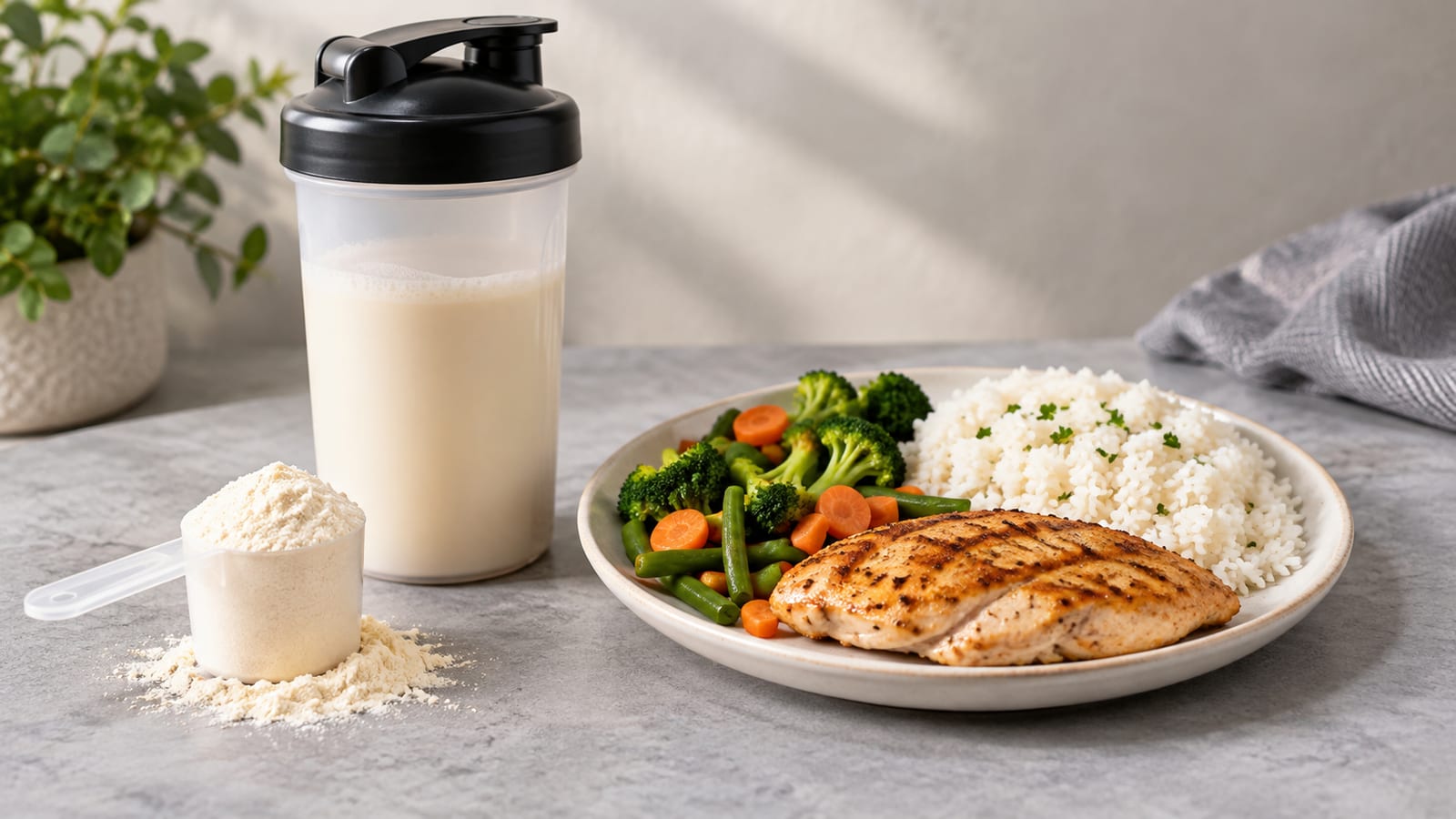
Whey is a complete dairy protein. It contains all the essential amino acids your body cannot make on its own, including the branched-chain amino acid leucine, which helps signal muscle protein building.
Whey concentrate is the best default for most people because it offers:
- Complete protein.
- Strong support for muscle growth.
- Good mixing and taste.
- Wide availability.
- A lower cost than many specialty formulas.
Whey isolate is filtered further. It usually contains less lactose and fewer carbohydrates and fats than concentrate. That can help if concentrate causes digestive symptoms or you want a leaner formula, but the extra cost is not automatically worth paying.
Choose concentrate if you digest dairy well and want the practical value choice. Choose isolate if lactose bothers you, a concentrate consistently causes symptoms, or you prefer its lighter texture. Neither form earns extra muscle simply because the label sounds more refined.
A shake works after lifting, at breakfast, or during a busy workday. The timing matters less than getting enough total protein and calories across the day.
Plant proteins work when the dose and blend are right
Vegan athletes can gain muscle with plant protein powder. The formula and serving size need more attention because plant proteins differ in amino acid balance and digestibility.
Soy isolate is the strongest single-ingredient plant choice for muscle gain. It provides a complete amino acid profile and works well in a shake or smoothie. It also tends to offer good value compared with more specialized plant formulas.
Pea protein contains plenty of useful protein but is lower in some amino acids than soy. Rice protein has a different amino acid pattern. A pea-and-rice blend combines their strengths and is the practical choice when dairy and soy don’t work for you.
Plant powders may need a larger serving to provide the same useful protein dose as whey. Follow the protein amount on the label rather than assuming one scoop always equals another. A small scoop of a thin plant blend may leave you short, especially if the rest of your diet is also low in protein.
Across dairy and plant powders, the main choices look like this:
| Protein type | Best use | Main trade-off |
|---|---|---|
| Whey concentrate | Lowest-cost default for most lifters | Contains some lactose |
| Whey isolate | Lower-lactose dairy option | Often costs more |
| Micellar casein | Filling shake or slower-digesting option | Thicker and not superior for total muscle gain |
| Soy isolate | Strong single-ingredient plant option | Not suitable for people avoiding soy |
| Pea-and-rice blend | Dairy-free and soy-free muscle support | May require more powder for the same protein dose |
If you follow a vegan bulking diet, pair this article with a practical vegan bulking meal plan for strength gains. The shake is only one part of the food plan.
Convenience is the main reason to use protein powder
Protein powder earns its place by making a difficult meal easier. It can help during a commute, a long workday, travel, a late class, or the trip home from the gym.
Useful combinations include:
- Whey with milk and a banana.
- Protein powder blended with oats and fruit.
- Soy or pea-and-rice powder with soy milk.
- A shaker bottle with powder packed separately from water.
- A shake alongside toast, cereal, fruit, or a sandwich.
A shake alone may not provide enough total food for a hard training day. Add carbohydrates when you need more training energy or recovery food. A banana, bagel, oats, cereal, or fruit can turn a thin drink into a more useful snack.
Portability matters more than novelty. A powder you can carry and tolerate beats a premium formula sitting unopened in your cupboard.
Post-workout protein helps, but the narrow window is overstated
Muscle repair continues for hours after training. You don’t need to panic if you can’t drink a shake before leaving the gym.
A protein-rich meal or shake within a convenient few-hour period is usually enough. If you ate a meal before training and dinner is soon afterward, you may not need a separate post-workout serving.
Use a shake sooner when:
- You trained without eating much beforehand.
- Your next meal is delayed.
- You have another session later.
- Travel makes a full meal difficult.
- You’re struggling to reach your daily protein target.
After training, combine protein with carbohydrates if the session was hard or you need to train again soon. Milk and cereal, yogurt with fruit, a chicken burrito, tofu with rice, or a shake with a banana can all do the job.
The best timing is the time that helps you eat enough without upsetting your stomach. For more detail, read this guide to the best time to take protein after a workout.
Protein powder versus whole foods
Whole foods provide more than protein. They can also supply fiber, vitamins, minerals, fluids, and enough volume to keep you satisfied. Meat, fish, eggs, dairy, tofu, tempeh, beans, lentils, and fortified soy foods all have a place in a muscle-gain diet.
Protein powder has a different job. It is compact, portable, quick to prepare, and easy to measure. That makes it useful when cooking is impossible or a full meal feels too heavy after training.
| Feature | Protein powder | Whole-food protein |
|---|---|---|
| Preparation | Fast mixing | May require cooking |
| Portability | Easy for travel and commutes | Depends on the food |
| Satiety | Often lower | Usually higher because of volume and chewing |
| Fiber | Usually little or none | Common in legumes, grains, nuts, and some plant foods |
| Vitamins and minerals | Depends on the formula | Often broader and more varied |
| Cost | Often economical per protein serving | Varies widely by food |
| Digestion | Depends on protein, sweeteners, and thickeners | Depends on the food and portion |
Don’t replace every meal with shakes. That often leaves you short on fiber, variety, and satisfaction. Use powder where it solves a real schedule problem, then let ordinary food carry the rest.
Protein powder can support weight loss, but it doesn’t cause it
A measured shake can provide substantial protein for relatively few calories. That may help you preserve muscle during a calorie deficit and make a lower-calorie eating plan easier to follow.
However, protein powder still contains calories. Large shakes with milk, nut butter, oats, oil, and several scoops can become a full meal without looking like one. Extra servings can erase the calorie deficit you meant to create.
For weight loss, keep the shake simple:
- Use the amount that fills your protein gap.
- Mix it with water or a lower-calorie milk if that suits you.
- Add fruit or oats only when you need more food.
- Keep high-calorie extras measured.
- Eat solid meals as well for fullness and nutrients.
The powder supports the plan. It does not override total intake.
Digestive tolerance determines the best powder
The best powder is the one you can digest and use consistently. A formula that causes bloating, gas, diarrhea, or stomach pain is a poor choice, even if its amino acid profile looks impressive.
Digestive trouble can come from several parts of a product:
- Lactose in dairy protein.
- Sugar alcohols and some sweeteners.
- Thickeners and gums.
- Large serving sizes.
- Drinking the shake too quickly.
- Mixing it with milk or other foods that also cause symptoms.
Test one change at a time. Start with a smaller serving, mix it with water, and use it on a normal day rather than before a competition. If it sits well, increase the amount when your meals require it.
Keep a simple note of the powder, serving size, liquid, timing, and symptoms. That gives you useful information instead of sending you through random formula changes.
Persistent diarrhea, vomiting, severe pain, blood in the stool, or symptoms that keep limiting training deserve medical advice. Another flavored tub is not a digestive plan.
Lactose intolerance calls for isolate or a dairy-free formula
Lactose intolerance means your body has trouble digesting lactose, the sugar in milk. Milk-protein allergy is different. It involves an immune reaction to milk proteins, so switching from whey concentrate to whey isolate may not make whey safe.
If you have lactose intolerance, try:
- Whey isolate.
- A lactose-free dairy protein.
- Soy isolate.
- A pea-and-rice blend.
- A plant formula with simple ingredients.
If you have a milk-protein allergy, avoid whey and casein unless a qualified clinician has told you otherwise. Read the full label because dairy ingredients can appear in blends and flavor systems.
You also don’t need to avoid whey because someone online reported bloating. Your tolerance is the useful test. Start cautiously and choose the formula that fits your body.
Budget, schedule, and training demand should decide the purchase
Buy protein powder for a specific problem. If your meals already cover your protein target and your schedule is stable, you may not need it.
Before buying, check:
- Cost per serving: Compare the actual protein servings, not tub size.
- Protein per scoop: A large scoop may still provide a modest amount.
- Ingredient list: Fewer ingredients can make troubleshooting easier.
- Protein type: Match dairy, soy, or other plant proteins to your tolerance.
- Frequency of use: A powder used daily deserves more scrutiny than an emergency travel option.
- Training demand: Hard sessions and double-session days create more need for convenient refueling.
- Food access: A kitchen, cafeteria, fridge, and meal-prep time can reduce the need for powder.
Look for products tested by an independent certification program if supplement contamination is a concern. NSF Certified for Sport is one program athletes can check when reviewing products. Also remember that supplement labels are not a substitute for sensible food choices or medical advice. The U.S. Food and Drug Administration’s supplement guidance explains the limits of supplement oversight.
How to use protein powder without overcomplicating nutrition
Use one serving when ordinary meals leave your daily protein target short. Mix it with water for the lightest option, milk or soy milk for more protein and calories, or blend it with fruit and oats when you need a fuller snack.
A simple routine looks like this:
- Eat breakfast, lunch, dinner, and normal snacks first.
- Estimate whether those meals cover your protein needs.
- Add one shake to the meal or time slot that causes the most trouble.
- Include carbohydrates if you need recovery energy.
- Review your digestion and hunger after several uses.
- Keep the powder if it helps. Drop it if it creates problems.
You don’t need a shake immediately after every workout. You do need enough protein, enough food, and a training plan that gives your muscles a reason to adapt.
The clearest picks
- Whey concentrate: Best default for muscle gain. It is complete, effective, widely available, and usually the lowest-cost option per serving.
- Whey isolate: Best whey choice if lactose causes symptoms or you want a leaner powder. The extra cost is not automatically worthwhile.
- Micellar casein: Useful when a thicker, more filling, slower-digesting shake suits your schedule. It is not superior to whey for total muscle growth.
- Soy isolate: Strongest single-ingredient plant alternative. It has a complete amino acid profile and good value.
- Pea-and-rice blend: Practical plant-based choice when dairy and soy are unsuitable. Use enough powder to match the protein dose you would get from whey.
FAQ
Can protein powder build muscle without lifting weights?
No. Protein powder can help you meet your protein needs, but muscle gain requires resistance training and enough total food. Without that training signal, extra protein does not create the same muscle-building result.
Is protein powder necessary for beginners?
No. Beginners can gain muscle with food alone if meals provide enough protein and calories. Powder becomes useful when appetite, schedule, cooking access, or food preferences make that difficult.
Is casein better than whey before bed?
Casein may feel more filling and digest more slowly, which can suit a bedtime snack. However, it has not earned a special muscle-growth advantage over whey when your overall daily protein intake is covered.
Can teenagers use protein powder?
Teen athletes should focus first on regular meals, training support, hydration, and sleep. A shake may help if a qualified sports dietitian or clinician identifies a genuine food gap, but young athletes should be cautious with large supplement stacks and extreme diets.
Does protein powder contain gluten?
Some protein powders are made without gluten, but flavorings, additives, or shared manufacturing equipment can affect the label. If you need strict gluten avoidance, check for a clear gluten-free statement and review the ingredient information.